
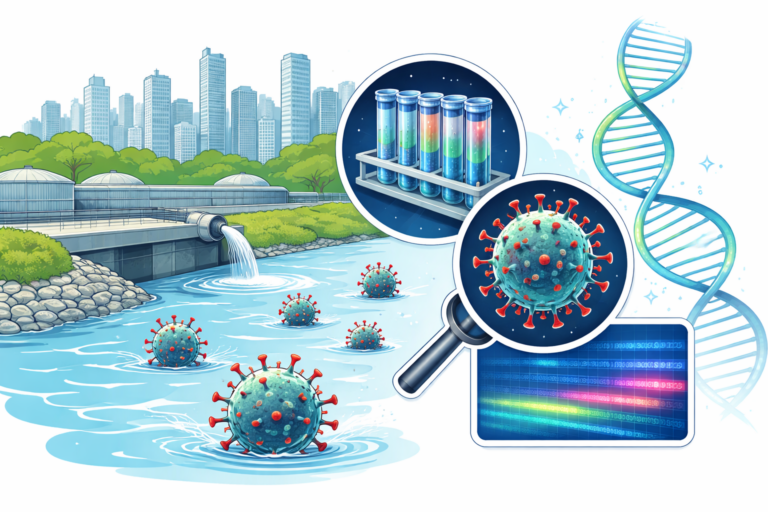
Wastewater-based epidemiology has emerged as a powerful, population-level tool for tracking infectious diseases, offering early insights into pathogen spread that are often missed by clinical testing alone. In a 2023 PLOS ONE laboratory protocol, Child et al. describe an optimized, high-throughput workflow for monitoring SARS-CoV-2 in influent wastewater samples, combining efficient viral enrichment, robust nucleic acid clean-up, and whole-genome sequencing to support national surveillance efforts in England.
A key challenge in wastewater surveillance is the presence of inhibitors and fragmented nucleic acids that can interfere with downstream PCR and sequencing. This study demonstrates how careful RNA purification dramatically improves sequencing performance. After viral concentration by ammonium sulfate precipitation, extracted wastewater RNA was subjected to an additional magnetic-bead clean-up step using Omega Bio-tek’s Mag-Bind® TotalPure NGS. This step proved critical: samples that underwent bead-based RNA clean-up consistently showed higher proportions of sequencing reads mapping to the SARS-CoV-2 genome, improved genome coverage, and greater sequencing depth compared to samples processed without clean-up.
The purified RNA was then reverse-transcribed and prepared for sequencing using a reverse-complement PCR (RC-PCR) workflow, which integrates tiled amplification and adapter addition in a single step. Throughout library preparation, Mag-Bind® beads were again used for size-selective post-PCR clean-ups, efficiently removing primers and PCR artifacts. Fragment analysis and sequencing data confirmed that these magnetic bead steps produced clean, high-quality libraries suitable for Illumina sequencing, even from challenging wastewater matrices.
Importantly, the protocol was validated at scale. The workflow supported sequencing of hundreds of wastewater samples per month as part of England’s Environmental Monitoring for Health Protection program, covering populations of tens of millions. Even samples with low or undetectable RT-qPCR signals frequently yielded partial to near-complete viral genomes, enabling sensitive detection of circulating variants. The authors highlight that whole-genome sequencing, when paired with effective nucleic acid purification, can outperform targeted PCR alone in inhibitor-rich environmental samples.
Overall, this study underscores the importance of reliable nucleic acid clean-up in wastewater genomics. Omega Bio-tek’s magnetic bead technologies played a central role in improving RNA quality and sequencing outcomes, helping transform complex wastewater samples into actionable genomic data for public health decision-making.