
Powering Liquid & Solid Biopsies with High-Quality Nucleic Acid
Mag-Bind® kits help unlock actionable insights
from every sample—liquid or solid.
Mag-Bind® DNA and RNA Purification Kits from Omega Bio-tek
Modern precision medicine depends on high-quality nucleic acids—especially when samples are limited, degraded, or precious. Whether working with circulating tumor DNA (ctDNA) from plasma or DNA/RNA from solid tissue biopsies, Mag-Bind® magnetic bead purification kits deliver the consistency, sensitivity, and scalability required for today’s molecular diagnostics and translational research.
Built for All Workflows
Mag-Bind kits are designed for manual, semi-automated, and fully automated workflows, making them ideal for clinical labs, biobanks, and high-throughput research environments.
- Magnetic bead chemistry with scripts optimized for liquid handlers and magnetic processors
- Scalable from single samples to 96-well formats
- Reduce hands-on time, improve reproducibility, and confidently scale your biopsy workflows
Liquid Biopsy

Liquid biopsies demand exceptional sensitivity and minimal loss. Mag-Bind kits are optimized to recover low-abundance nucleic acids from challenging biofluids.
Supported samples include:
- Plasma
- Serum
- Urine
Why Mag-Bind for liquid biopsy?
- Optimized for the recovery of short, fragmented cfDNA
- Consistent yields across low-input samples
- Clean DNA ready for NGS, PCR, and methylation analysis
Ready to try our cfDNA extraction kit?
Solid Biopsy
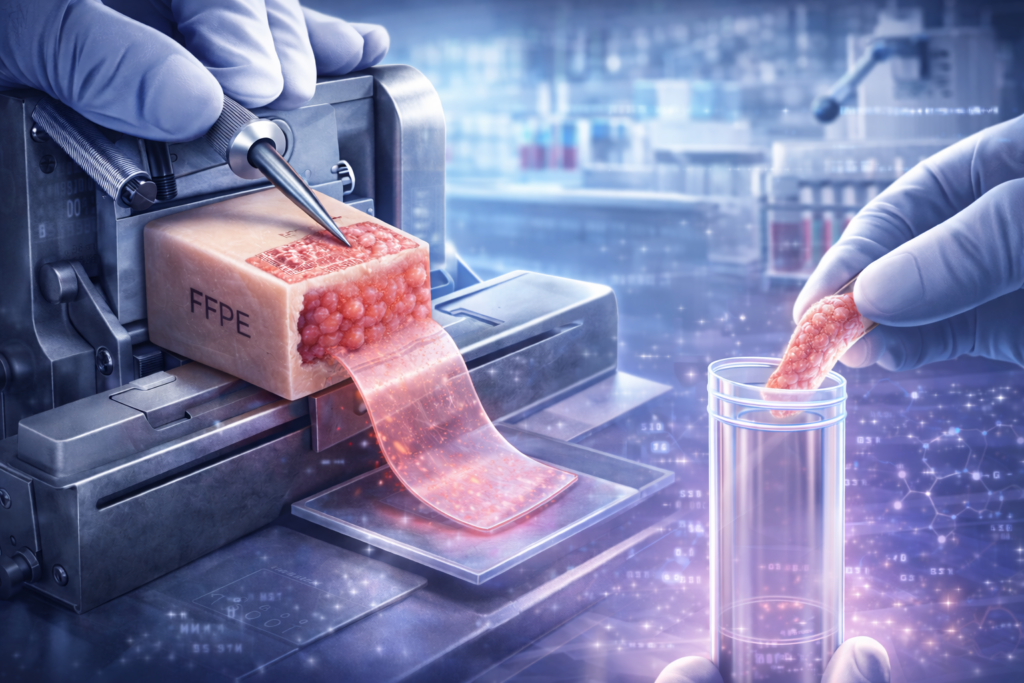
Solid tissue samples often introduce inhibitors, crosslinking, or degradation. Mag-Bind chemistry is engineered to handle these complexities while preserving nucleic acid integrity.
Supports sequential purification of DNA and RNA:
- Efficiently use limited sample volume
- Improves yield and consistency
- Reduces hands-on time and reagent use
Why Mag-Bind for solid biopsy?
- Efficient removal of proteins, salts, and inhibitors
- Reliable extraction from FFPE and compromised samples
- Reproducible results across tissue types
Ready to try our FFPE DNA and RNA extraction kit?