



|
Omega Bio-tek's U.S. offices will be closed October 12th for Columbus Day. We look forward to serving you October 13th! |
$0.00 – $1,032.60Price range: $0.00 through $1,032.60
All Mag-Bind® kits can be automated on most programmable robotic platforms, liquid handlers or magnetic processors. Learn more.
Off-the-shelf product doesn’t suit your needs? We’ll work with you to develop a customized product. Learn more.
Dedicated applications support will consult with you to develop and implement an automated solution that fits your specifications. Learn more.
Scripts available for all Mag-Bind® Kits for most open liquid handlers and common magnetic processors including the MagBinder® Fit24. Visit Automated Solutions for more information.
The Mag-Bind® Endo-free Plasmid Midi Kit is designed to deliver large scale purification of high-quality plasmid DNA with endotoxins levels <0.1 EU/µg for use in eukaryotic transfections and other sensitive in vitro applications.
The Kit follows magnetic bead-based technology to purify plasmid DNA from up to 50 mL bacterial culture in LB or up to 10 mL bacterial culture in TB or other suitable growth medium. The Mag-Bind® Endo-free Plasmid DNA Kit can be processed either manually or automated on most open-ended liquid handling platforms as well as magnetic processors. Yields may vary depending on the copy number of the plasmid, E. coli strain used, culture media, and condition of growth.
The Mag-Bind® Endo-free Plasmid Midi Kit follows a modified alkaline lysis method forming a bacterial lysate. The lysate is then cleared using either Mag-Bind® Particles LC (sold separately) or Lysate Clearance Filter Syringe (sold separately) or centrifugation. The novel paramagnetic lysate clearance beads bind to cell debris and pull them down when magnetized. This eliminates the need for centrifugation or vacuum manifold for lysate clearance, making this suitable for high-throughput, automation workflows.
Post lysate clearance, plasmid DNA is then bound to Mag-Bind® Particles RQ through a specially formulated binding buffer and the Mag-Bind® particles are subjected to a wash routine to remove endotoxins, salt, and other contaminants. High-quality plasmid DNA is then eluted in Endo-free Water and is ready for use in a wide range of downstream applications such as transfection routine screening, restriction enzyme digestion, transformation, PCR, and DNA sequencing, etc.
For Research Use Only. Not for use in diagnostic procedures.
| Feature | Specifications |
|---|---|
| Starting Amount | up to 50 mL bacterial culture in LB or up to 10 mL bacterial culture in TB |
| Starting Material | Bacteria harboring high-copy or low-copy plasmid in LB, TB, or other suitable culture medium |
| Elution Volume | 100 µL |
| Technology | Magnetic beads |
| Processing Mode | Automated, Manual |
| Throughput | 1 - 24 |
| Processing Time | 24 samples in ~ 70 minutes |
| Endotoxin levels | < 0.1 EU/µg |
| Purity | Contamination-free plasmid DNA with A260/A280 > 1.8 and A260/A230 > 1.8 |
| Lysate Clearance Methodology | Magnetic beads, Centrifugation or Syringe |
| Downstream Applications | Transfection, routine screening, restriction enzyme digestion, transformation, PCR, DNA sequencing, in vitro transcription, and other sensitive applications requiring pure DNA |
| Component | Available Separately |
|---|---|
| Solution I | Solution I |
| Solution II | Solution II |
| N3 Buffer | |
| IRD Buffer | IRD Buffer |
| VHB Buffer | VHB Buffer |
| Endo-free Water | |
| Mag-Bind® Particles RQ | Mag-Bind® Particles RQ |
| RNase A | RNase A |
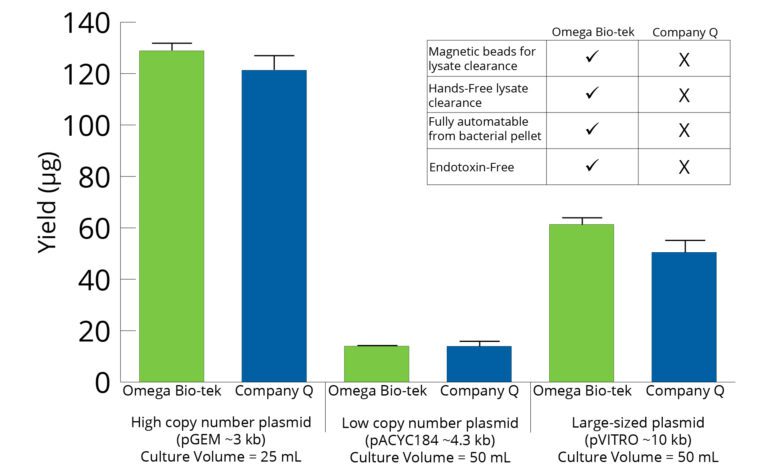
Figure 1. A variety of plasmid types and sizes were purified from DH5α cultures (n=3) using the Mag-Bind® Endo-free Plasmid Midi Kit, in addition to an equivalent kit from Company Q, following respective manufacturers’ recommended protocols. Purified Plasmid DNA was quantified using Thermo Scientific’s NanoDrop™ 2000c system. Plasmid yields were comparable for all plasmid types, irrespective of the extraction kit used. Inset table shows advantages of Omega Bio-tek’s Kit over Company Q’s Kit
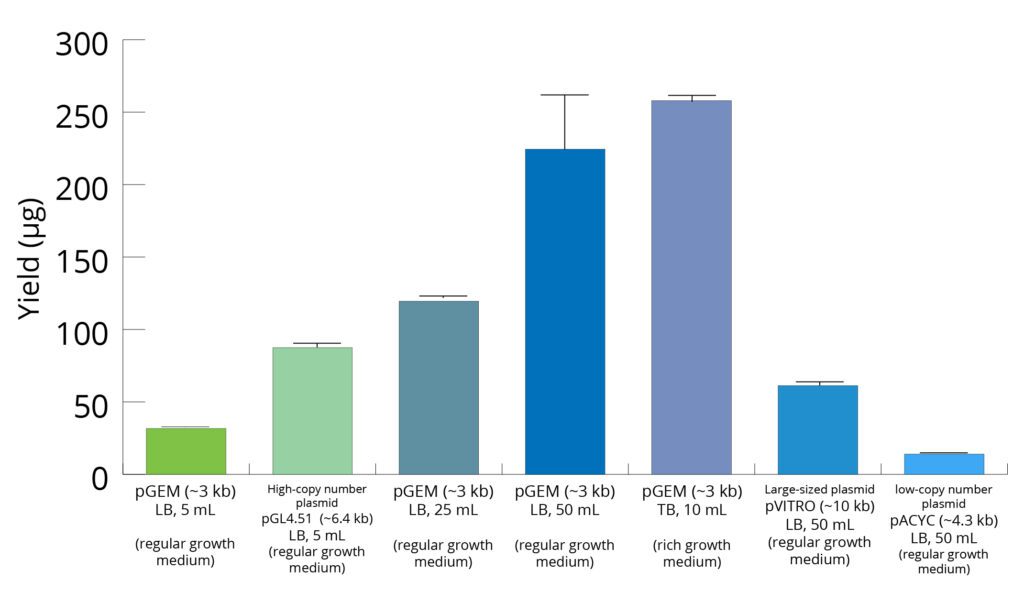
Figure 2. Mag-Bind® Endo-free Plasmid Midi Kit is capable of handling diverse sample input conditions ranging from plasmid types, plasmid sizes, culture medium, and input culture volumes. The plasmid yield may vary based on these conditions.
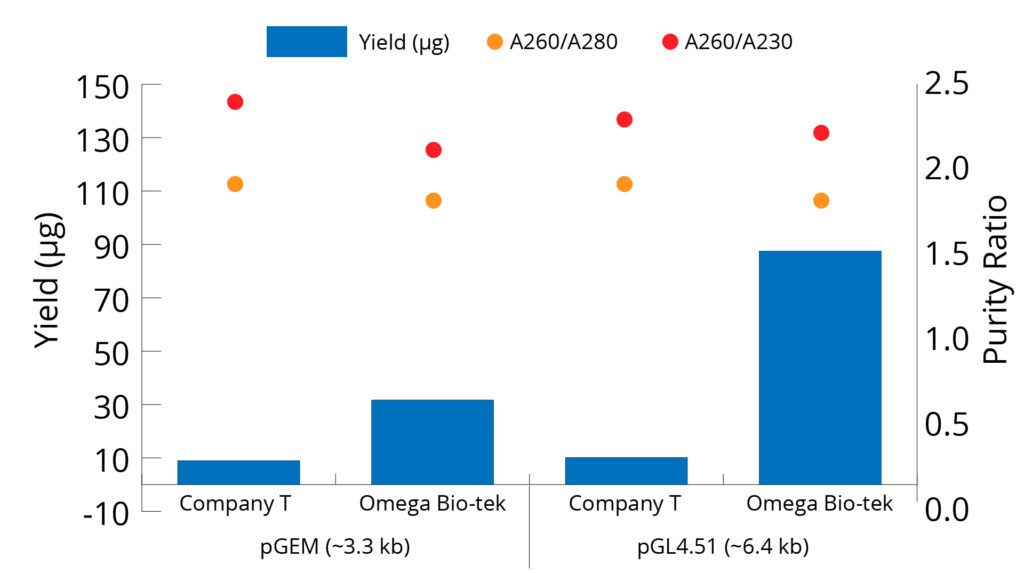
Figure 3. pGEM and pGL4.51 plasmids were purified from 5 mL DH5α cultures (n=3) using the Mag-Bind® Endo-free Plasmid Midi Kit on the MagBinder® Fit24 Nucleic Acid Purification System, as well as Company T’s Kit following manufacturers’ recommended centrigation protocols. Purified Plasmid DNA was quantified using Thermo Scientific’s NanoDrop™ 2000c system. Plasmid purification was not only endotoxin-free (<0.1 EU/μg) for Omega Bio-tek’s Kit, but the yield was also significantly higher compared to Company T’s Kit.
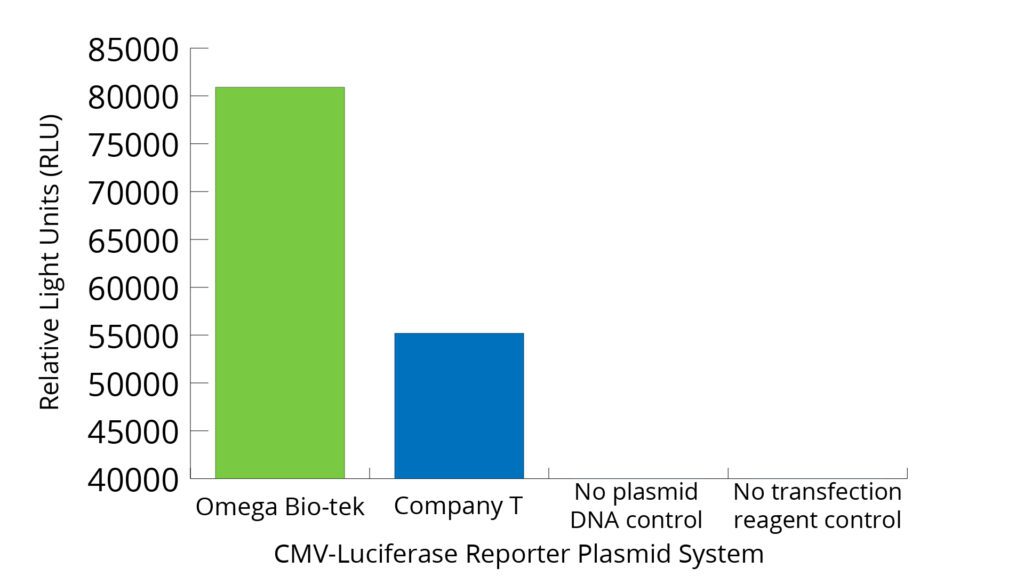
Figure 4. Plasmid pGL4.51 was prepared from 5 mL DH5α cultures (n=3) and purified using the Mag-Bind® Endo-free Plasmid Midi Kit on the MagBinder® Fit24 Nucleic Acid Purification System, as well as Company T’s equivalent Kit. Purified Plasmids were transfected into 10,000 cells with 200 ng of purified plasmid using 2 μL Lipofectamine Transfection Reagent. Plasmids purified using Omega Bio-tek’s Kit resulted in higher bioluminscent signal, indicating higher transfection efficiency compared to plasmids purified using Company T’s Kit.
| Plasmid Type | Manufacturer | Yield (µg) | A260/A280 | A260/A230 |
|---|---|---|---|---|
| pGEM (~3.3 kb) | Omega Bio-tek | 31.7 | 1.8 | 2.1 |
| Company T | 9.0 | 1.9 | 2.4 | |
| pGL4.51 | Omega Bio-tek | 87.5 | 1.8 | 2.2 |
| Company T | 10.2 | 1.9 | 2.3 |
Figure 5. pGEM and pGL4.51 plasmid were purified from 5 mL DH5α cultures (n=3) using Mag-Bind® Endo-free Plasmid Midi Kit on the MagBinder® Fit24 and Company T’s Kit, following manufacturer’s recommended centrifugation protocol. Purified Plasmid DNA was quantified using Thermo Scientific’s NanoDrop™ 2000c system. Plasmid preparation was not only endotoxin-free (< 0.1 EU/μg) for Omega Bio-tek’s kit, but the yield was also significantly higher compared to Company T’s kit.
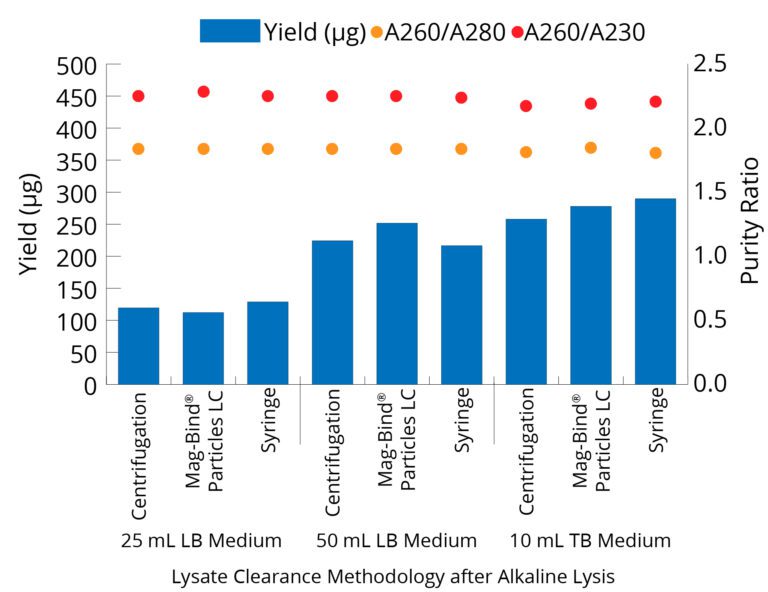
Figure 6. pGEM plasmid was purified from 25 mL and 50 mL LB as well as 10 mL TB media (n=3) using Mag-Bind® Endo-free Plasmid Midi Kit automated on the MagBinder® Fit24 Platform following three different lysate clearance methodologies. Yields and quality were comparable, irrespective of the lysate clearance methodology used.
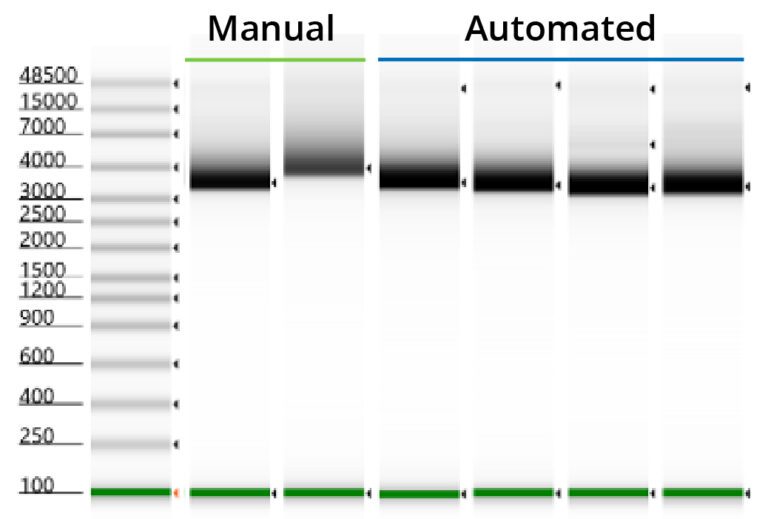
Figure 7. pGEM Plasmid DNA was extracted from 50 mL bacterial pellet manually using the Mag-Bind® Endo-free Plasmid Midi Kit, according to manufacturer’s instructions, as well as using the Kit automated on Dynamic Devices’ Lynx platform. TapeStation analysis shows comparable integrity between the two methods.
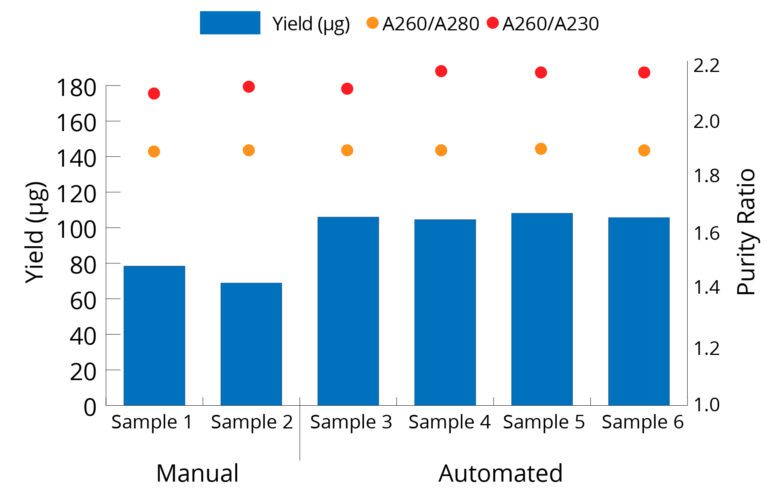
Figure 8. pGEM Plasmid DNA was extracted from 50 mL bacterial pellet manually using the Mag-Bind® Endo-free Plasmid Midi Kit, according to manufacturer’s instructions, as well as using the Kit automated on Dynamic Devices’ Lynx platform. Average yields were 1.5X higher for automated extraction vs. manual. A260/A280 and A260/A230 ratios were comparable between the two methods.