Efficient, Streamlined Genomic DNA Extraction from Dried Blood Spots
September 30, 2025
Adrian Harris¹, Carisa Townsend¹, Kiranmai Durvasula¹, Julie Baggs¹, and Travis Butts¹
Omega Bio-tek, Inc., Norcross, GA 30071
Introduction
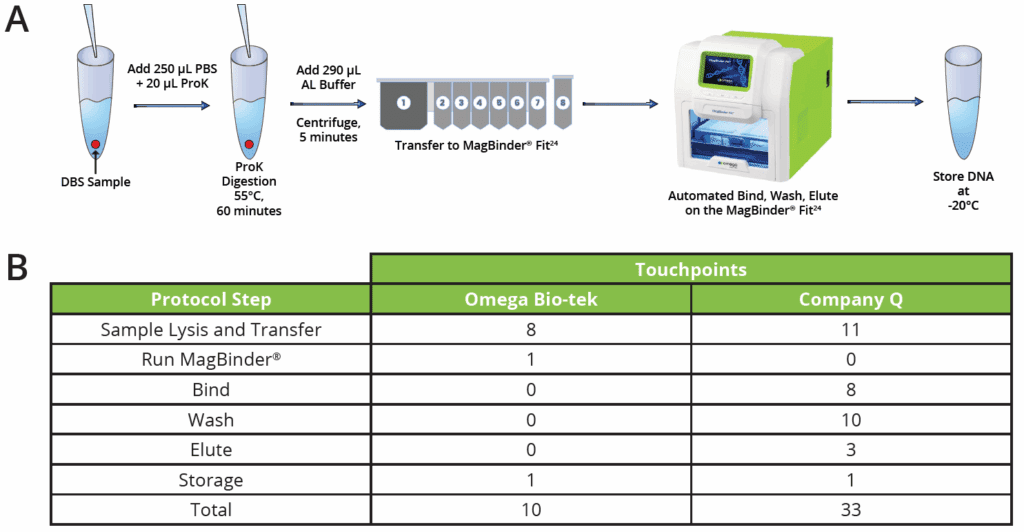
Dried Blood Spots (DBS) have become an invaluable resource in medical research and diagnostics, offering a convenient, low-cost method for collecting, transporting, and storing blood samples. Although most commonly used in newborn screening, DBS are now widely applied in large-scale epidemiological studies, forensics, population genetics, infectious disease monitoring, and biomarker discovery. However, reliably extracting high-quality DNA from DBS has remained a challenge, often requiring labor-intensive protocols that increase variability and hands-on time. Here, we present a user-friendly protocol that addresses these limitations with a semi-automated workflow that significantly reduces manual touchpoints from 33 using a competitor’s (Company Q) kit to 10 with our prefilled MB Fit24™ Blood & Tissue DNA Kit. By streamlining the extraction process while ensuring robust DNA yield and integrity, our solution empowers researchers to process DBS samples more efficiently and consistently, thereby unlocking the full potential of these samples for downstream applications such as PCR, sequencing, and genotyping.
Learn more about the Mag-Bind® Blood & Tissue DNA HDQ 96 Kit.
Materials and Methods
SampleCollection and Extraction 100 μL of human whole blood from four different blood lots was dispensed onto their own Whatman™ 903 Proteinsaver Sample Collection Card. Subsequently, three 5 mm blood spots were punched out from each lot’s respective card. Upon collection, DNA was extracted using Omega Bio-tek’s MB Fit24™ Blood & Tissue DNA Kit (B6399-5-48PF) automated on the MagBinder® Fit24 Nucleic Acid Purification System according to the manufacturer’s protocol for Dried Blood Spot Extraction. At the same time, DNA was extracted using a comparable column-based kit from Company Q for comparison. Figure 1 illustrates Omega Bio-tek’s extraction protocol (A), as well as the progression of the total number of touchpoints from sample lysis to storage (B). In addition to requiring fewer touchpoints, the MB Fit24™ Blood & Tissue DNA Kit uses a single incubation step versus three incubation steps at different temperatures with Company Q’s kit. The MagBinder® Fit24 reduced hands-on time by 30 minutes compared to the competing kit, offering a more efficient workflow and reduced labor demand.
Yield and Quality The yield and quality of the extracted DNA was evaluated with a PicoGreen quantification assay and a genomic DNA ScreenTape assay on the Agilent 4150 TapeStation, respectively.
Downstream Analysis qPCR was used to assess the suitability of DNA extracted for use in downstream applications. Amplification was performed using human-specific primers on 10-fold and 100-fold dilutions of the purified DNA.
Semi-Automated DNA Extraction Workflow from Dried Blood Spots on MagBinder® Fit24 Platform
Figure 1. Protocol for extracting DNA from DBS using the prefilled MB Fit24™ Blood & Tissue DNA Kit on the MagBinder® Fit24 from Omega Bio-tek (A). Omega Bio-tek's protocol is capable of extracting genomic DNA from up to 24 samples with 10 total touchpoints from sample lysis to eluate storage (B). By automating with the MagBinder® Fit24, users reduce the number of touchpoints for the Bind, Wash, and Elute steps to zero.
Results and Discussion
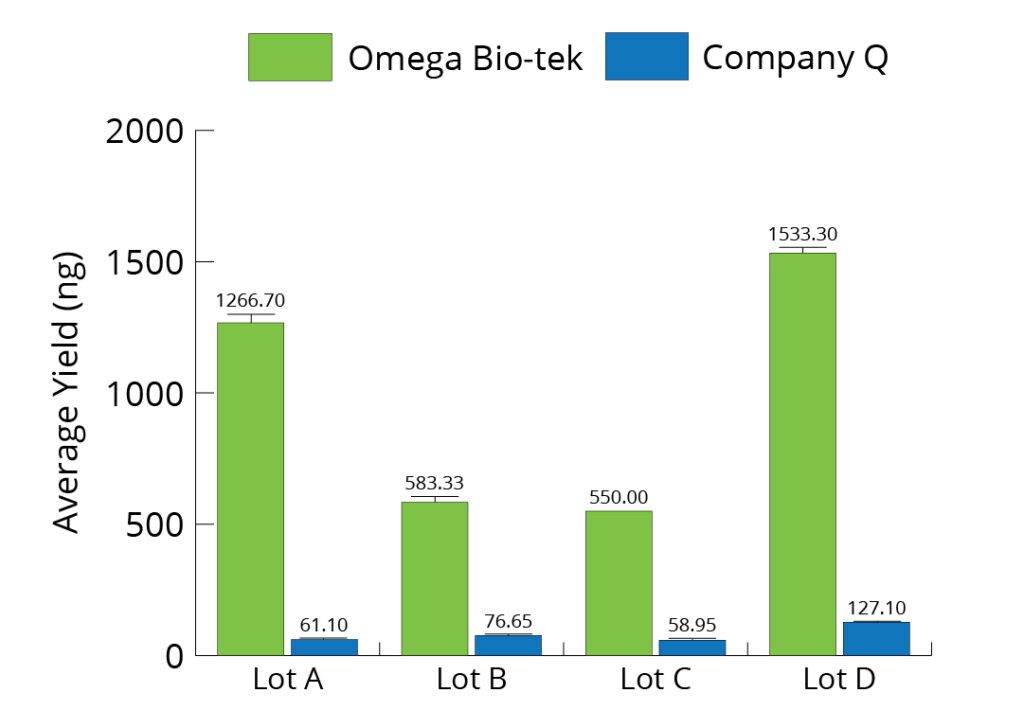
A PicoGreen quantification assay was used to analyze yields of the extracted DNA from each lot of blood (Figure 2). DNA yields were significantly higher when extraction was performed using the MB Fit24™ Blood & Tissue DNA Kit compared to the competing kit from Company Q.
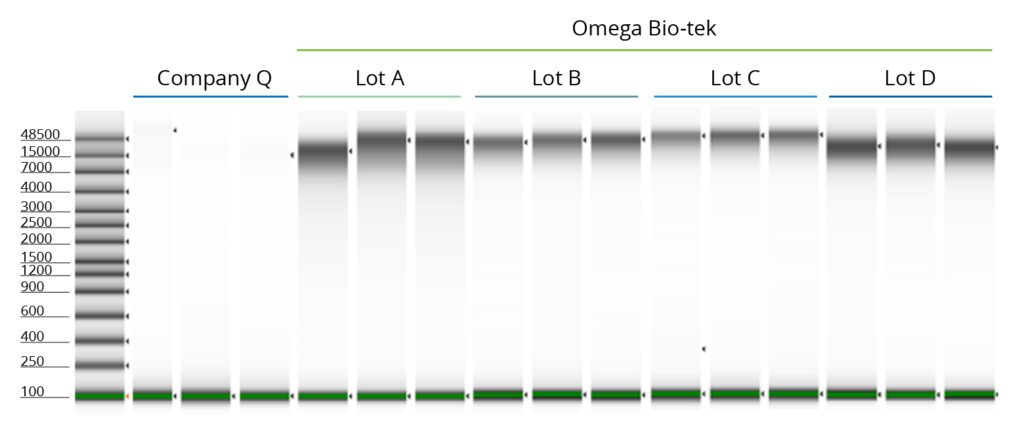
Purified DNA from all four blood lots was also analyzed via Genomic DNA ScreenTape Assay on the TapeStation 4150 (Figure 3). A representative sample is shown for Company Q, as DNA extracted using this kit was outside the quantitative range of the TapeStation for all four blood lots due to low DNA yields. The DNA purified using Omega Bio-tek’s Kit and protocol was of high molecular weight and showed a well-defined band above 15 kb. Overall, TapeStation analysis showed high integrity DNA extracted with Omega Bio-tek’s Kit.
Significantly Higher Yields of DNA Compared to Company Q
Figure 2. DNA was purified from three 5 mm punch-outs of dried blood spots from four lots of blood (n=3). PicoGreen analysis illustrated that extraction using Omega Bio-tek’s Kit resulted in significantly higher yields of DNA compared to Company Q.
TapeStation Analysis of DNA Purified Using the MB Fit24™ Blood & Tissue DNA Kit
Figure 3. TapeStation analysis of DNA extracted from DBS from each of the four blood lots illustrates bands of DNA above 15 kb for all samples extracted using the MB Fit24™ Blood & Tissue DNA Kit on the MagBinder® Fit24. DNA Purified using an equivalent kit from Company Q was outside of quantitative range of the TapeStation® 4150, therefore a representative sample is shown.
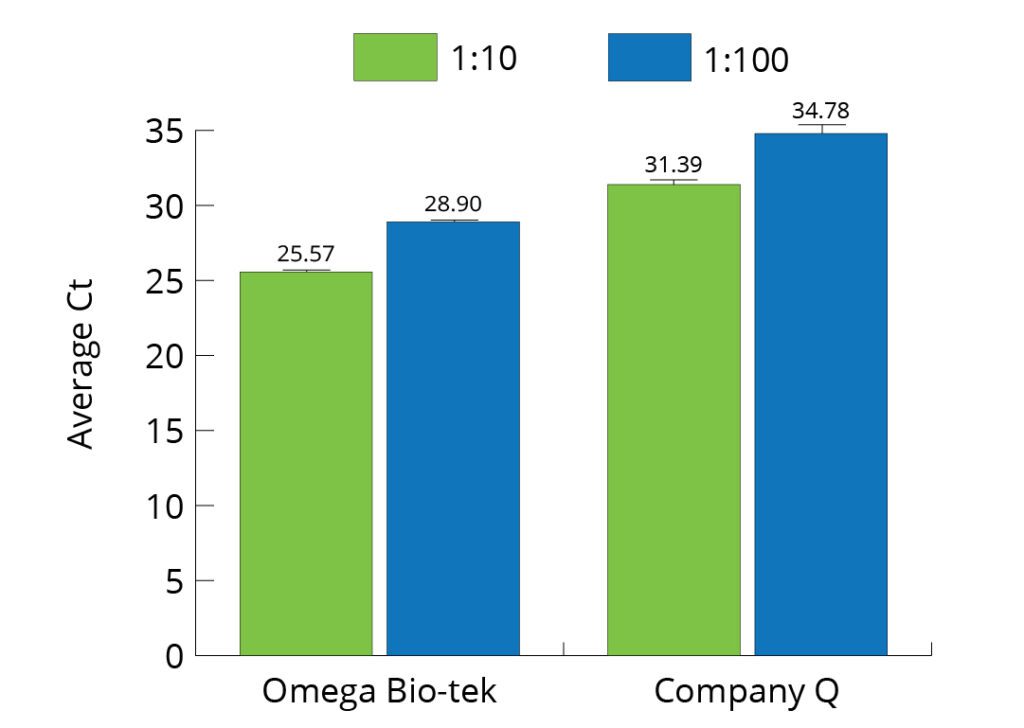
qPCR was performed on 10-fold and 100-fold dilutions of purified DNA from Blood Lot 4 using Omega Bio-tek’s MB Fit24™ Blood & Tissue DNA Kit and supplemental protocol, as well as an equivalent kit and protocol from Company Q (Figure 4). DNA extracted with Omega Bio-tek’s Kit yielded Ct values that were ~5.8 cycles lower than Company Q’s kit at both 10-fold and 100-fold dilutions, indicating higher DNA recovery and greater sensitivity for downstream detection. In addition, the average ΔCt between 10-fold and 100-fold dilutions was ~3.3 for both kits, indicating no PCR inhibitors present in the purified DNA.
Inhibitor-Free DNA Extracted Using the MB Fit24™ Blood & Tissue DNA Kit
Figure 4. Average Ct values obtained from amplifying the purified DNA from Blood Lot D using Omega Bio-tek’s Kit and protocol, as well as an equivalent kit and protocol from Company Q. The Ct values using Omega Bio-tek’s kit were lower compared to Company Q’s, indicative of higher DNA yields obtained using Omega Bio-tek’s kit.
Conclusions
Overall, the MB Fit24™ Blood & Tissue DNA Kit automated on the MagBinder® Fit24 provides a reliable and efficient workflow for extracting high yields of inhibitor-free DNA from DBS. In addition, Omega Bio-tek’s workflow outperforms an equivalent workflow from Company Q, while maintaining efficiency with significantly fewer touchpoints compared to Company Q. Automating DNA extraction from Dried Blood Spots using the MB Fit24™ Blood & Tissue DNA Kit on the MagBinder® Fit24 allows the researcher more time to focus on other tasks without compromising the yield and quality of their extractions.
We use cookies to ensure that we give you the best experience on our website. If you continue to use this site we will assume that you are happy with it.