Claudia Pitzl¹, Christina Holzinger¹, Kiranmai Durvasula², Julie Baggs², and Travis Butts²
¹ingenetix GmbH, Vienna, Austria
²Omega Bio-tek, Inc, Norcross, GA 30071
Introduction
Cell-free DNA (cfDNA) isolated from maternal plasma is widely used in non-invasive prenatal testing (NIPT) such as Fetal Rhesus Factor D (RhD) genotyping which determines whether an RhD incompatibility exists between mother and child. NIPT enables fetal RhD determination with a standard blood draw while avoiding risks associated with invasive tests like amniocentesis and chorionic villus sampling. Because cfDNA is typically highly fragmented and present at low concentrations, reliable extraction methods are critical for obtaining nucleic acids of sufficient quality and quantity for sensitive downstream amplification assays.
The FetoGnost® Kit RHD, developed by ingenetix, is a multi-plex real-time PCR assay designed to detect fetal RHD sequences in maternal plasma. The assay targets multiple exons of the RHD gene and includes an internal positive control (IPC) that serves as a control to verify successful cfDNA isolation and amplification.
Learn more about the MB Fit24™ cfDNA Kit automated on the MagBinder® Fit24.
Workflow Illustration
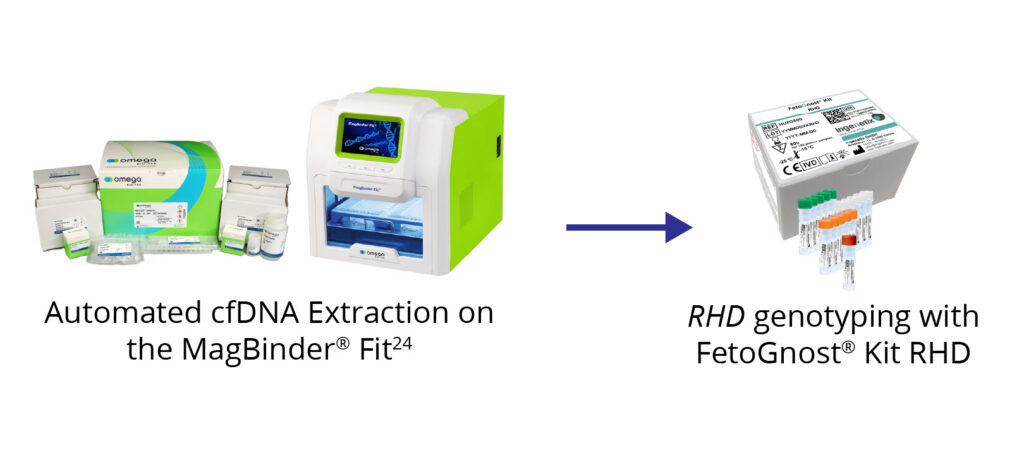
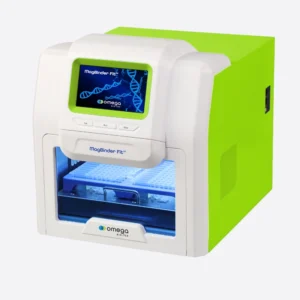
Therefore, efficient and reproducible cfDNA extraction is a critical first step for reliable downstream detection. The MB Fit24™ cfDNA Kit (B3298) enables semi-automated purification of cfDNA from plasma using the MagBinder® Fit24 Nucleic Acid Purification System, providing a streamlined workflow for laboratories. This Kit comes in automation-ready cartridges that are pre-filled with reagents, increasing convenience for laboratory technicians by eliminating the need for reagent preparation and buffer dispensing.
Here, cfDNA extracted using the MB Fit24™ cfDNA Kit (B3298) on the MagBinder® Fit24 was evaluated for compatibility with the FetoGnost® Kit RHD (Figure 1). Both the 1 mL and 2 mL plasma input protocols were tested using positive and negative plasma samples. Purified cfDNA was analyzed with the FetoGnost® RHD assay to assess amplification performance.
Materials and Methods
Sample Preparation
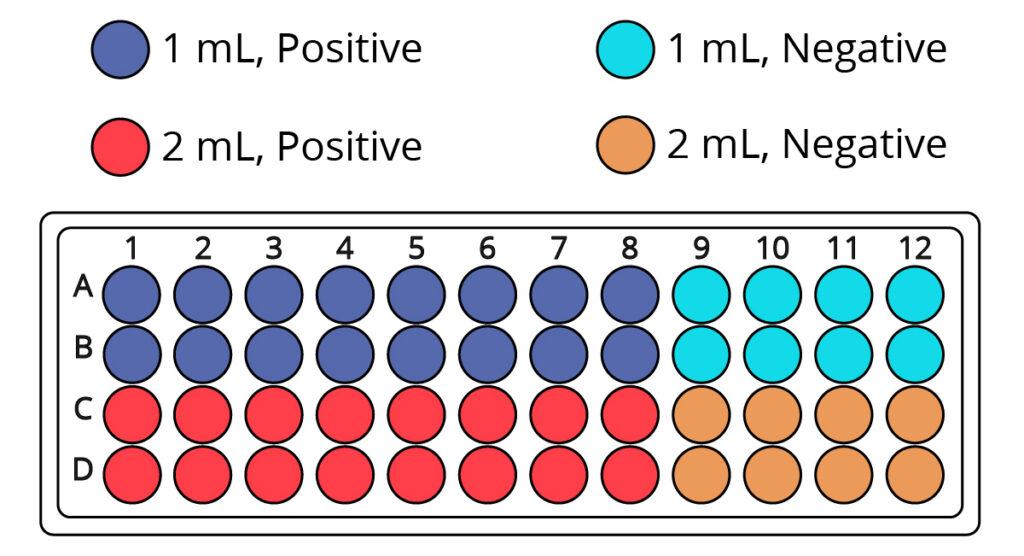
Plasma pools consisting of positive and negative samples were used to evaluate cfDNA extraction performance. The study included 8 positive plasma pools and 4 negative plasma pools, each processed in duplicate for both 1 mL and 2 mL plasma input volume protocols. In total, 48 samples were tested across the two workflows.
cfDNA Extraction
cfDNA was isolated using the MB Fit24™ cfDNA Kit (B3298) on the MagBinder® Fit24 Nucleic Acid Purification System according to manufacturer’s instructions for 1 mL and 2 mL plasma input volumes.
qPCR Analysis
Purified cfDNA was analyzed using the FetoGnost® Kit RHD, a multiplex quantitative PCR assay designed to detect three genomic targets and a co-extracted internal positive control (IPC). Positive samples were expected to produce amplification signals for Exons 5, 7, and 10, as well as the IPC, while negative samples were expected to produce amplification only for the IPC. Amplification was monitored using the appropriate fluorescence channels for each target, and quantification cycle (Cq) values were recorded to evaluate extraction performance. Figure 2 illustrates the layout of samples on the PCR plate.
PCR Plate Layout of Plasma Samples
Results and Discussion
Both the 1 mL and 2 mL protocols produced signals in all required channels. Positive samples showed signals in the VIC channel for Exon 5, FAM for Exon 7, NED for Exon 10, and CY5 for IPC (Figure 3A, Figure 4). As expected, negative samples only showed signals in CY5 for the IPC (Figure 3B, Figure 4D). The Cq values for the internal positive control (IPC) ranged from 32.3 to 35.9, and no significant difference was observed between the 1 mL and 2 mL sample groups. The overall mean across both positive and negative samples is 33.65, which falls within the predetermined Cq range for the FetoGnost® Kit of 28-36 (Figure 4D).
For positive samples, Cq values ranged from 32.9 to 37.2, comfortably within the specified range of 32 to 40. There was no significant difference found between the 1 mL and 2 mL approaches, though the 2 mL samples showed results slightly sooner, as expected (Table 1 & Figure 4). These results indicate high sensitivity of detection even with a lower sample input of 1 mL. Overall, 100% of RhD-positive samples (n=16) exhibited consistent exon detection in both replicates, while 100% of RhD-negative samples (n=8) showed no exon detection in either replicate, indicating complete concordance with expected sample status. The IPC was consistently detected in both replicates regardless of RhD status (Table 2). Both protocols produced consistent results and demonstrated the compatibility of the MB Fit24™ cfDNA Kit (B3298) with the FetoGnost® Kit RHD for downstream detection of fetal RHD sequences.
Amplification Plots of Positive and Negative Samples

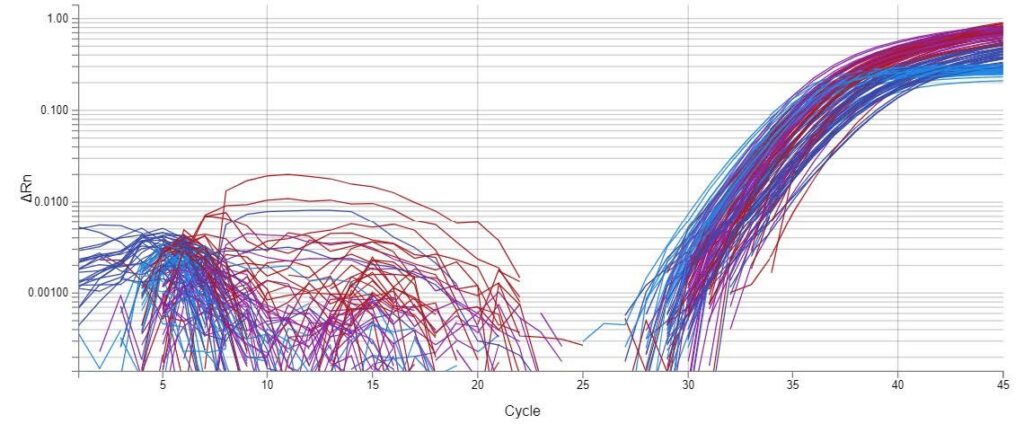
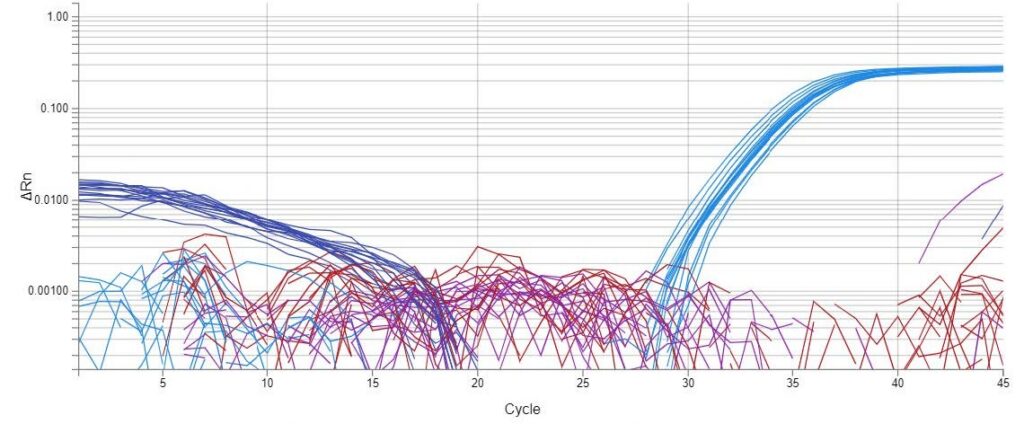
Figure 3. Logarithmic amplification plots of the positive (A) and negative (B) samples with color-coded targets: VIC for Exon 5, FAM for Exon 7, NED for Exon 10, and CY5 for IPC. All positive samples produced signals in each channel. For negative samples, only the IPC produced signal.
Amplification Plots in VIC, FAM, NED, and CY5 Channels for Exon 5, 7, 10 and IPC Detection

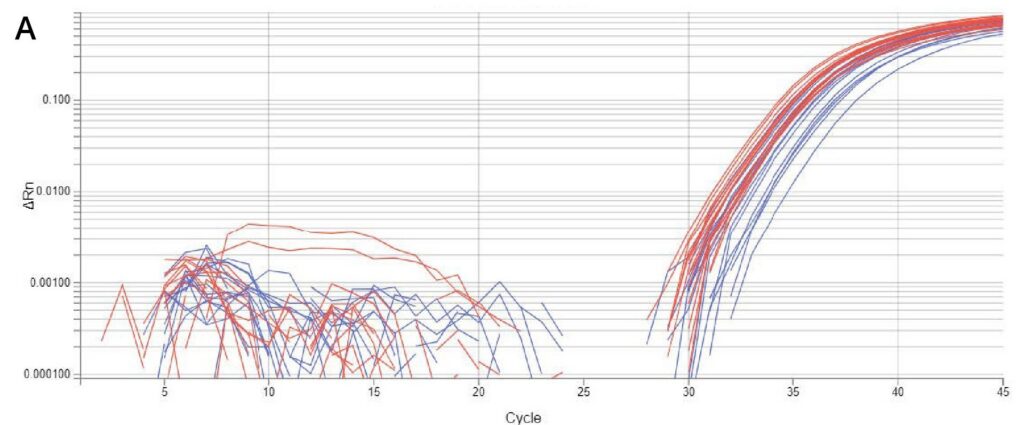
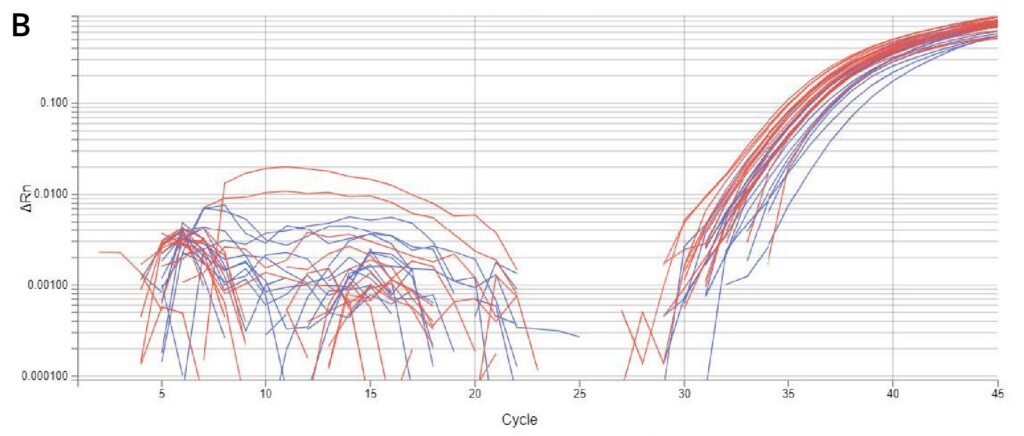
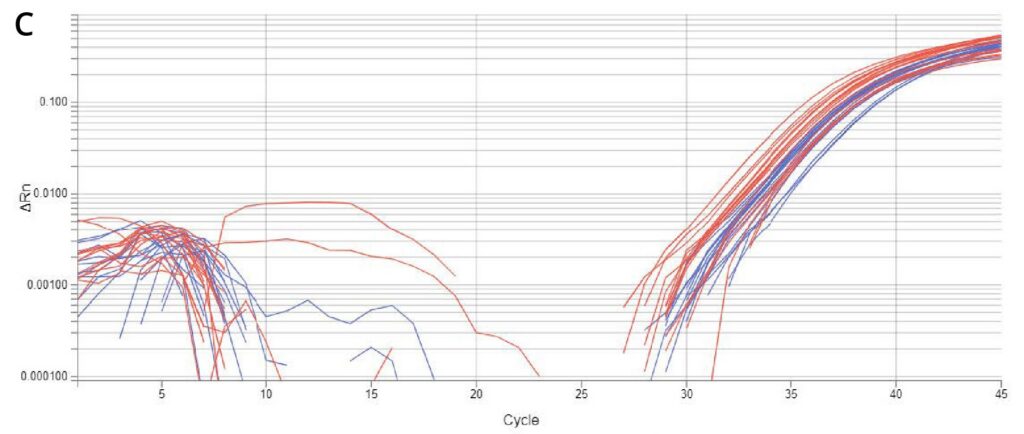
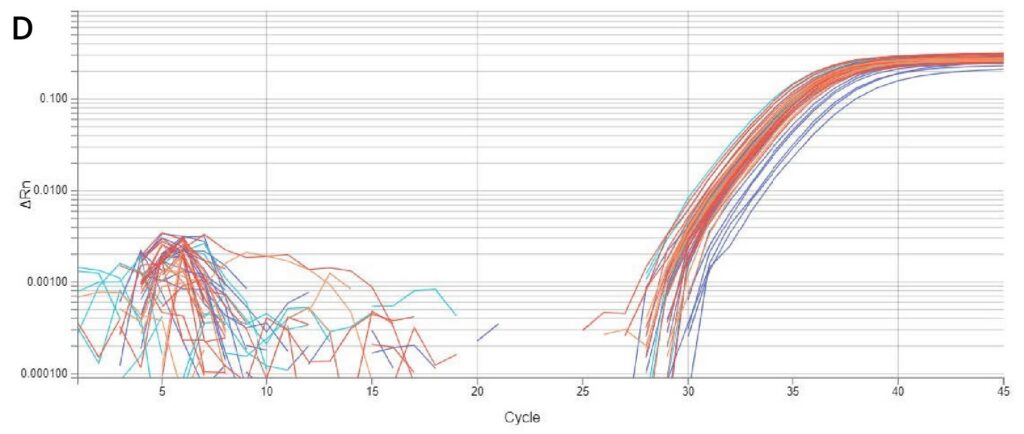
Figure 4. Logarithmic amplification plots in the VIC Channel for Exon 5 Detection (A), FAM Channel for Exon 7 Detection (B), NED Channel for Exon 10 Detection (C), and CY5 Channel for IPC Detection (D). Red and orange samples were extracted using the 2 mL protocol, while blue samples were extracted using the 1 mL protocol.
Table 1. Average Cq Values of cfDNA extracted using both the 1 mL and 2 mL extraction protocols. As expected, negative samples only detected signals for the IPC while positive samples detected signals from all three exons and the IPC.
| Exon 5 | Exon 7 | Exon 10 | IPC | |
|---|---|---|---|---|
| 1 mL, Negative (n=4) | Undetermined | Undetermined | Undetermined | 33.18 ± 0.53 |
| 1 mL, Positive (n=8) | 34.67 ± 0.85 | 35.12 ± 0.84 | 36.12 ± 0.81 | 34.19 ± 0.85 |
| 2 mL, Negative (n=4) | Undetermined | Undetermined | Undetermined | 33.53 ± 0.37 |
| 2 mL, Positive (n=8) | 33.75 ± 0.41 | 34.26 ± 0.66 | 35.25 ± 0.75 | 33.41 ± 0.49 |
Table 2. Detection accuracy of target exons and the IPC in known RhD-positive and known RhD-negative samples.
| Total Samples (n=24) | Exon 5 Tested in Duplicate | Exon 7 Tested in Duplicate | Exon 10 Tested in Duplicate | IPC Tested in Duplicate | ||||||||
|---|---|---|---|---|---|---|---|---|---|---|---|---|
| 2/2 | 1/2 | 0/2 | 2/2 | 1/2 | 0/2 | 2/2 | 1/2 | 0/2 | 2/2 | 1/2 | 0/2 | |
| RhD-Positive Samples (n=16) | 16 (100%) | 0 | 0 | 16 (100%) | 0 | 0 | 16 (100%) | 0 | 0 | 16 (100%) | 0 | 0 |
| RhD-Negative Samples (n=8) | 0 | 0 | 8 (100%) | 0 | 0 | 8 (100%) | 0 | 0 | 8 (100%) | 8 (100%) | 0 | 0 |
Conclusions
The evaluation of the MB Fit24™ cfDNA Kit (B3298) on the MagBinder® Fit24 Nucleic Acid Purification System demonstrates reliable and reproducible extraction of cfDNA from plasma, with both 1 mL and 2 mL input protocols producing robust amplification compatible with the FetoGnost® Kit RHD. All positive and negative samples performed as expected, with Cq values consistently within the validated range, confirming successful cfDNA purification and downstream assay compatibility.
Together, these results support a streamlined, plug-and-play workflow in which plasma samples can be directly loaded into the MB Fit24™ cfDNA Kit cartridges, processed on the MagBinder® Fit24, and analyzed using the FetoGnost® Kit RHD without additional optimization. This integrated approach enables laboratories to move from sample to result with minimal hands-on time, reducing workflow complexity while maintaining high confidence in fetal RhD detection.