Semi-Automated Solution for Isolation of Pathogen DNA/RNA on Omega Bio-tek’s MagBinder® Fit24

Authors: Brandon Easparro¹, Claire McClain¹, Steven Cupello¹, Tesfaye Kemsi¹, and Travis Butts¹

  1. Omega Bio-tek, Inc. Norcross, GA 30071

Abstract

Timely and accurate identification of pathogens causing urinary tract infections (UTIs) is vital for effective treatment planning. Traditional urine culture methods, while commonly used, can be time-consuming, taking several days to pinpoint responsible pathogens, and may lack reliability due to lower sensitivity compared to more modern techniques like PCR. A rapid and dependable nucleic acid extraction method plays a crucial role in efficiently determining the root cause of UTIs, from sample collection to obtaining the final result. Herein, we present a semi-automated nucleic acid extraction workflow utilizing stabilized urine as input, enabling the identification of bacterial and viral targets through qPCR. 

Materials and Methods

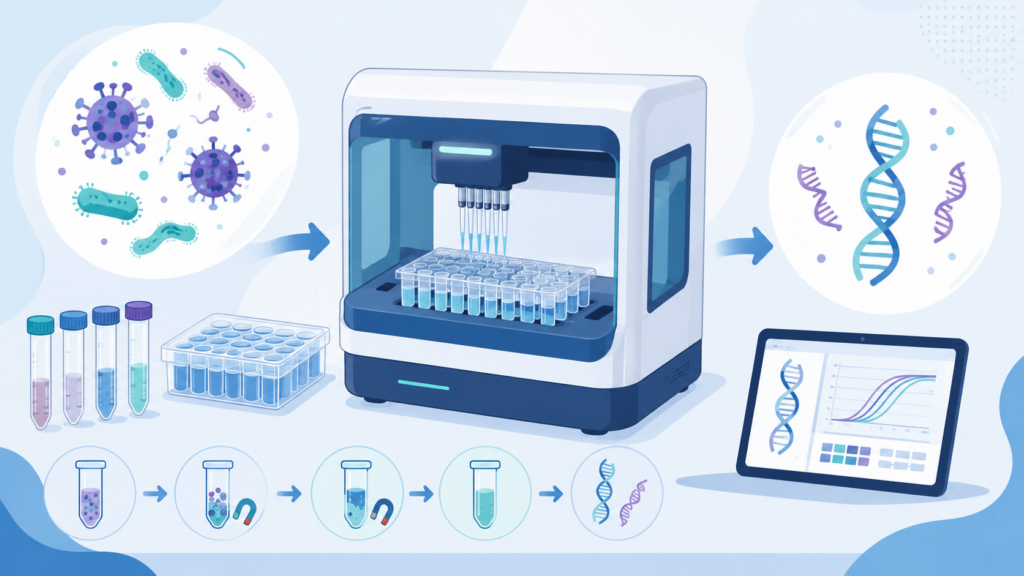
Streamlined Workflow from Sample Collection to Downstream Applications

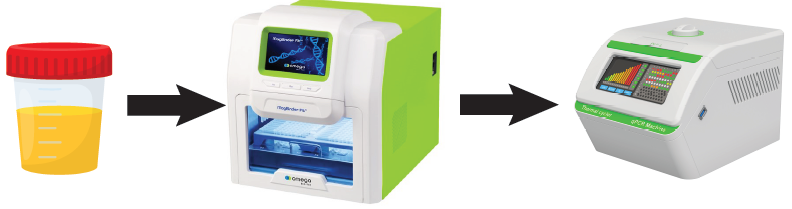
Sample Collection

Extraction with the
MagBinder® Fit24

Downstream Applications

Figure 1. Illustration of the workflow from sample collection to DNA extraction with Omega Bio-tek’s MagBinder® Fit24 to implementation in downstream applications.

Pathogen DNA Extraction Solution using the Mag-Bind® Universal Pathogen Kit on the MagBinder® Fit24

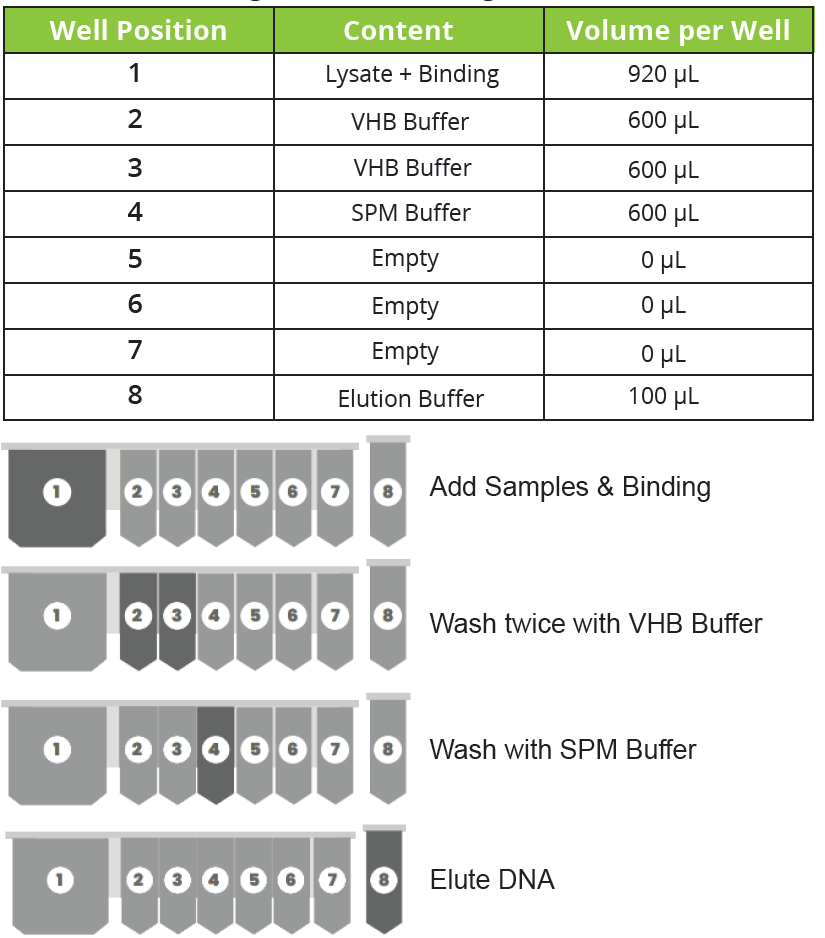
Figure 2. 200 µL urine (n=3, BioChemazone) was spike with B. subtilis pellet, and 100 µL human-derived plasma (n=3, Lampire) was spike with 100 µL Influenza A/B (Zeptometrix). Pathogen DNA extraction was automated using the Mag-Bind® Universal Pathogen Kit on the MagBinder® Fit24; extraction was also performed manually using the same kit, following manufacturer’s instructions. Positions, contents, and volumes of 5 mL reagent cartridge for the MagBinder® Fit24 shown above.

Quantitative PCR

The extracted DNA was subjected to real-time PCr using respective B. subtilis or Influenza A/B targets to evaluate its suitability for downstream applications. Average Ct values were determined.

Results

Average Ct Values from DNA Purified from Stabilized Urine

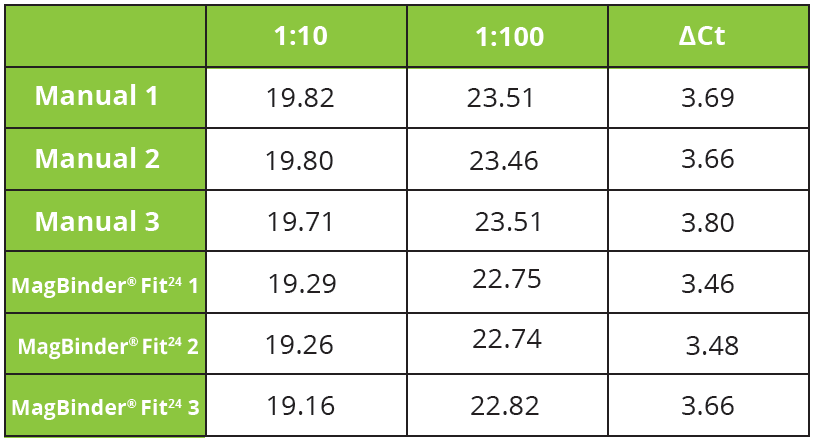
Figure 3. Average Ct values of Pathogen DNA extracted from 200 µL of synthetic urine. ΔCt values ~3.3, the expected ΔCt value for 10-fold and 100-fold dilutions, indicate positive amplification and efficiency for both manual and MagBinder® Fit24 extraction methods.

Average Ct Values from DNA Purified from Human-Derived Plasma

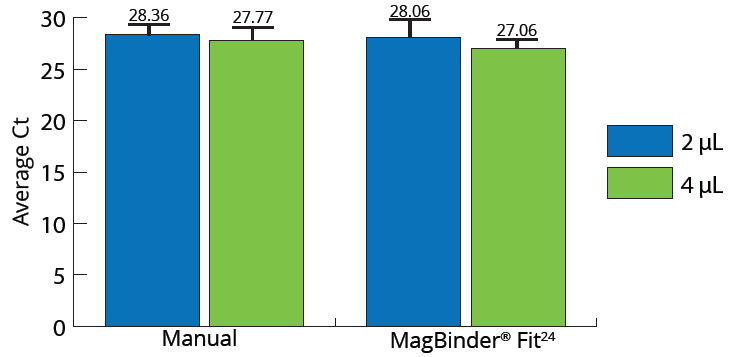
Figure 4. Average Ct values of Pathogen DNA extracted from 100 µL human-derived plasma using Mag-Bind® Universal Pathogen Kit on the MagBinder® Fit24 vs manual extraction methods. The expected ΔCt value between 2 µL and 4 µL inputs is ~1. Here, we observe ΔCt values of 0.59 and 1.00 for manual and MagBinder® Fit24 extractions, respectively, showing that pathogen DNA extraction can be automated on the MagBinder® Fit24 without sacrificing downstream performance.

Conclusions

  • Size and integrity of extracted pathogen DNA appropriate for downstream applications.
  • 24 samples can be extracted in approximately 60 minutes with the MagBinder® Fit24 and Mag-Bind® Universal Pathogen Kit.
  • Pathogen DNA extraction can be automated on the MagBinder® Fit24 without sacrificing downstream performance.

WP-0054

Featured Products

Interested in the MagBinder® Fit24? Tell us about your project!

MagBinder Information Request
Do you require a CE-IVD device?
Are you interested in a demonstration?
CAPTCHA

Shopping Cart
Scroll to Top