All Mag-Bind® kits can be automated on most programmable robotic platforms, liquid handlers or magnetic processors. Learn more.
Off-the-shelf product doesn’t suit your needs? We’ll work with you to develop a customized product. Learn more.
Dedicated applications support will consult with you to develop and implement an automated solution that fits your specifications. Learn more.
Scripts available for all Mag-Bind® Kits for most open liquid handlers and common magnetic processors including the MagBinder® Fit24. Visit Automated Solutions for more information.
Mag-Bind® Universal Pathogen 96 Kit rapidly and reliably isolates high-quality host genomic DNA, gram-positive and gram-negative bacterial DNA, fungal spore DNA, and viral DNA and viral RNA from tissue, urine, serum, and fecal samples.
This novel system combines the rapid magnetic response time of Mag-Bind® technology with the uniquely formulated RBB Buffer to eliminate the isolation of PCR-inhibiting compounds along with the nucleic acids of interest. No organic extractions are involved, reducing plastic waste and hands-on time, making it amenable for high-throughput applications. Purified DNA is suitable for a variety of applications including NGS, PCR, restriction digestion, etc.
The Mag-Bind® Universal Pathogen 96 Kit is automatable on most open liquid handlers and magnetic processors, with typical automated processing time of about 1 hour for 96 samples.
Ready-to-implement protocols are available for the following platforms:
Hamilton Microlab® STAR
Hamilton Microlab® NIMBUS
KingFisher™, BioSprint®, and MagMAX® 96
For Research Use Only. Not for use in diagnostic procedures.
Figure 1. Cryptosporidium oocysts were added to corresponding sample types and isolated with Mag-Bind® Universal Pathogen Kit. 20 µL SYBR® qPCR was performed in triplicate on primers specific for the target organism. Average of triplicate data shown.
Detection of Gram-Positive Bacteria
Figure 2. Group B strep cultured samples were added to corresponding sample types and isolated with Mag-Bind® Universal Pathogen Kit. 20 µL SYBR® qPCR was performed in triplicate on primers specific to the target organism. Average of triplicate data shown.
Detection of Gram-Negative Bacteria
Figure 3. E. coli cells were cultured overnight in LB broth and added to corresponding sample types and isolated with Mag-Bind® Universal Pathogen Kit. 20 µL SYBR® qPCR was performed in triplicate on primers specific to the target organism. Average of triplicate data shown.
Detection of Viral DNA
Figure 4. HBV viruses were added to corresponding sample types and isolated with Mag-Bind® Universal Pathogen Kit. 20 µL SYBR® qPCR was performed in triplicate on primers specific to the target organism. Average of triplicate data shown.
Detection of Viral RNA
Figure 5. Influenza A/B virus was added to corresponding sample types and isolated with Mag-Bind® Universal Pathogen Kit. 20 µL SYBR® qPCR was performed in triplicate on primers specific to the target organism. Average of triplicate data shown.
Inhibitor-free Gram-Positive Bacteria Isolation
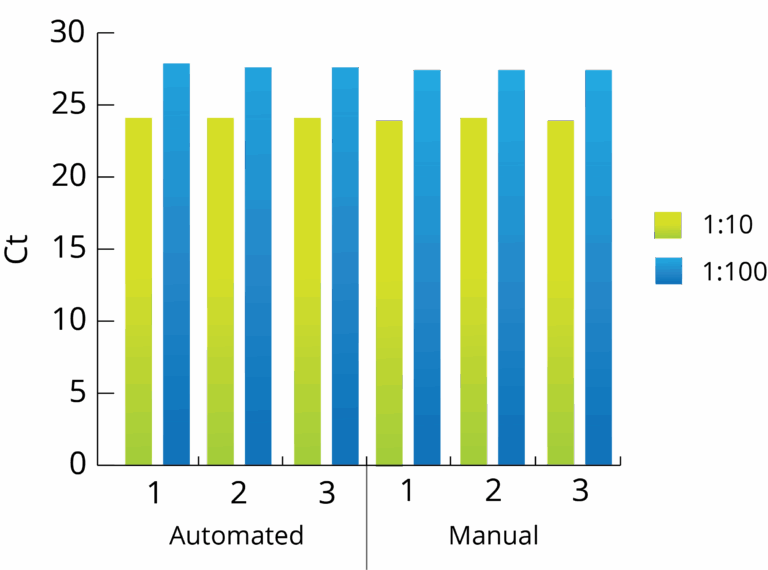
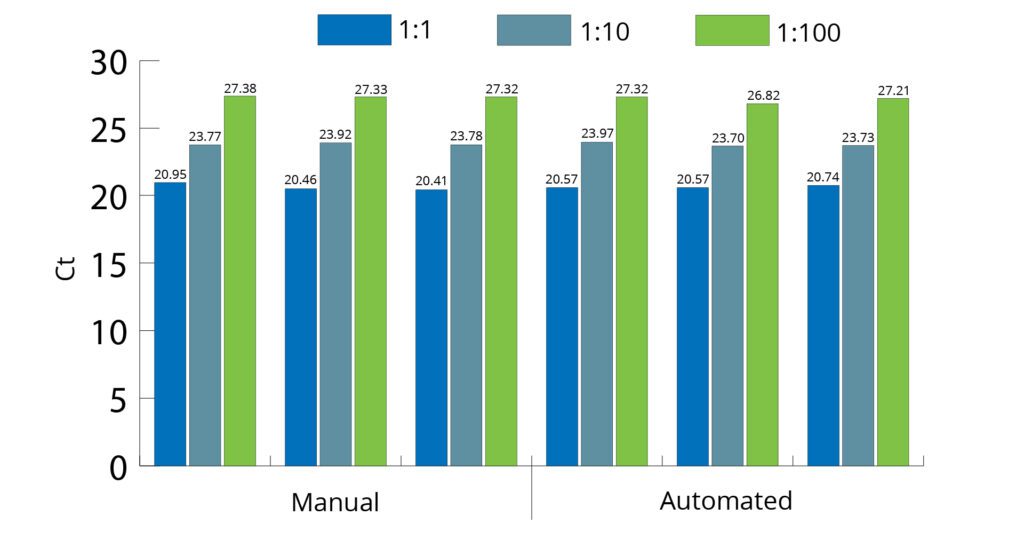
Figure 6. Gram Positive Bacteria Bacillus subtilis was spiked into stool samples and isolated using the Mag-Bind® Universal Pathogen 96 Kit. Automated isolation was performed using the KingFisher Flex and compared to manual isolation methods. qPCR was performed in triplicate on 10-fold and 100-fold dilutions. The ΔCt across dilutions was ~3.3 for both manual and automated methods, indicating minimal inhibition.
Inhibitor-free Yeast Isolation
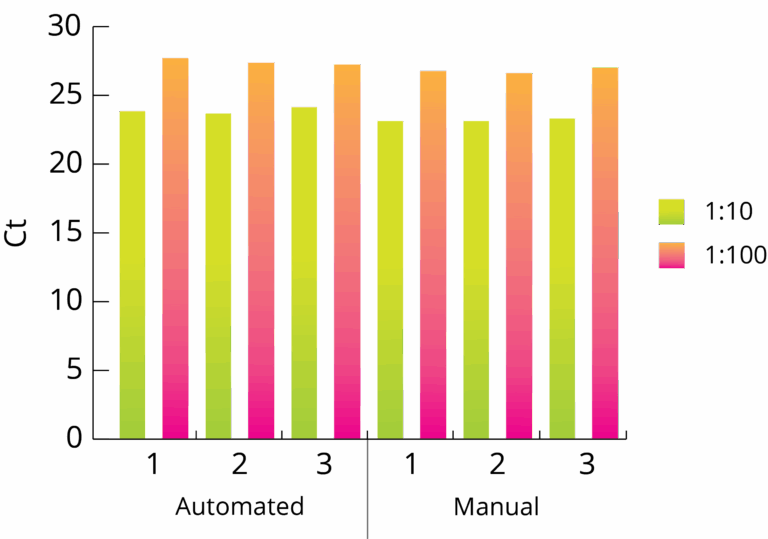
Figure 7. Yeast species Saccharomyces cerevisiae was spiked into stool samples and isolated using the Mag-Bind® Universal Pathogen 96 Kit. Automated isolation was performed using the KingFisher Flex and compared to manual isolation methods. qPCR was performed in triplicate on 10-fold and 100-fold dilutions. The ΔCt across dilutions was ~3.3 for both manual and automated methods, indicating minimal inhibition.
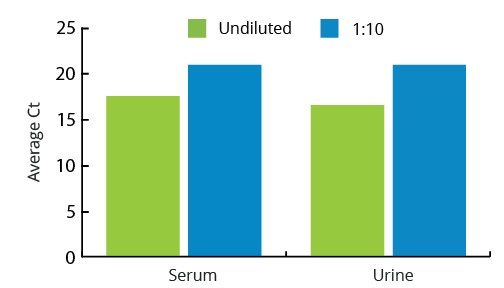
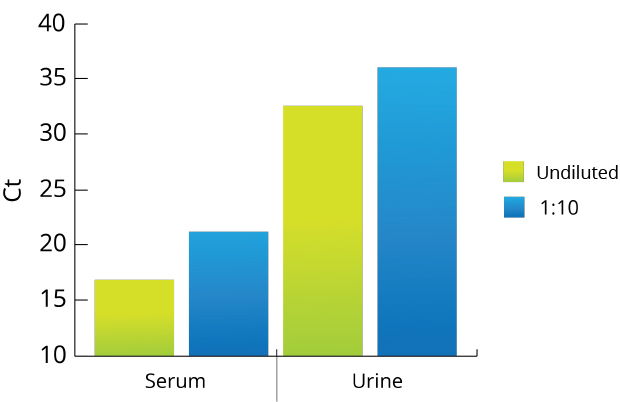
Figure 8. The gram-negative bacteria E. coli was spiked into serum and urine samples and isolated using the Mag-Bind® Universal Pathogen 96 Kit. Automated isolation was performed using the KingFisher Flex. qPCR was performed in triplicate on undiluted and 10-fold dilutions. The ΔCt across dilutions was consistent for both sample types
Consistent Protozoan Isolation
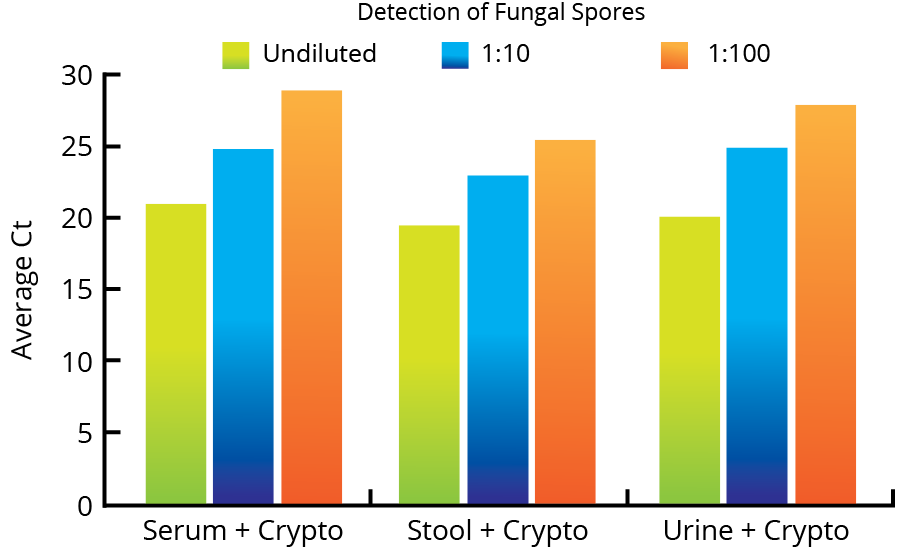
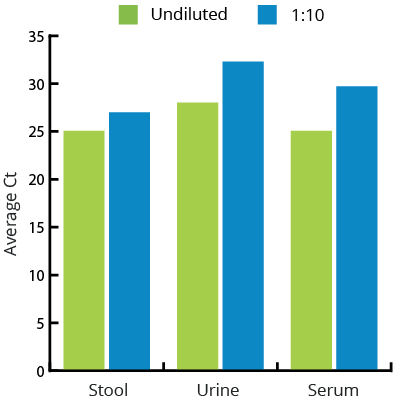
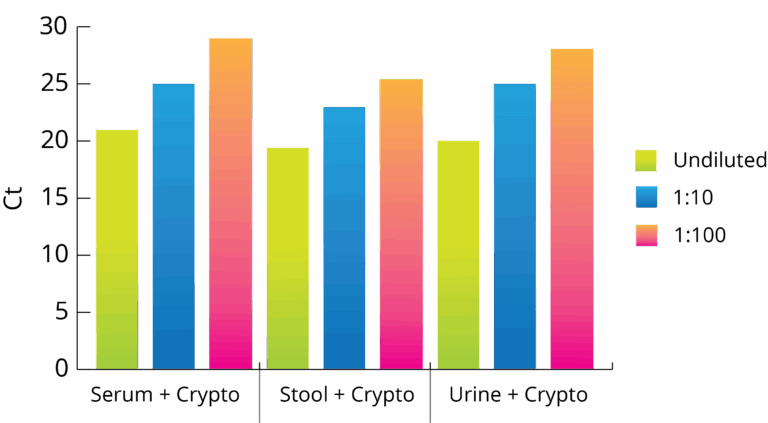
Figure 9. Cryptosporidium oocysts were spiked into corresponding sample types and isolated using the Mag-Bind® Universal Pathogen 96 Kit automated on the KingFisher Flex. 20 µL SYBR® qPCR was performed in triplicate on primers specific for the target organism. Average of triplicate data shown. The ΔCt across dilutions was consistent for all sample types.
Detection of Viral DNA Across Sample Types
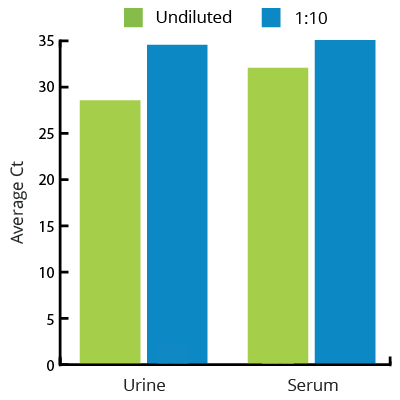
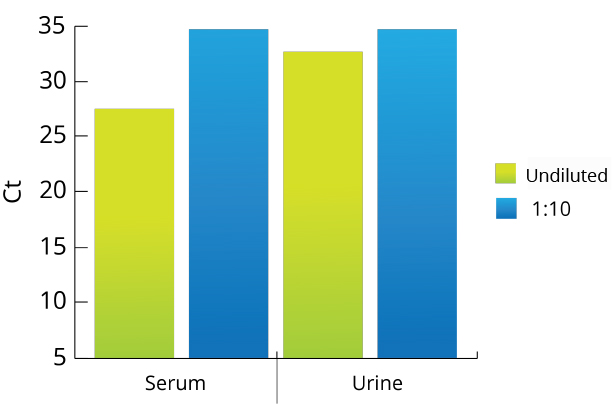
Figure 10. Hepatitis B virus was spiked into serum and urine samples and isolated using the Mag-Bind® Universal Pathogen 96 Kit. Automated isolation was performed using the KingFisher Flex. qPCR was performed in triplicate on undiluted and 10-fold dilution.
Detection of Viral RNA Across Sample Types
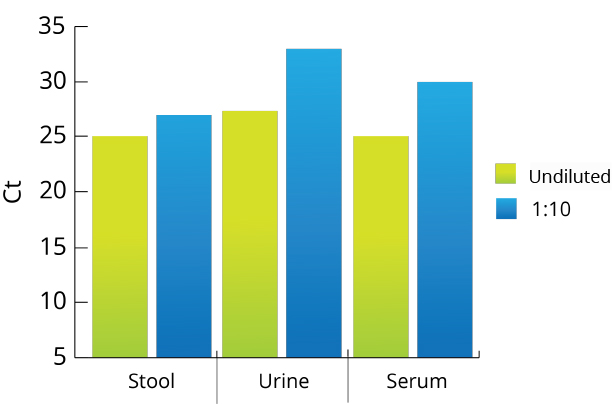
Figure 11. Influenza A/B virus was spiked into stool, urine, and serum samples and isolated using the Mag-Bind® Universal Pathogen 96 Kit. Automated isolation was performed using the KingFisher Flex. qPCR was performed in triplicate on undiluted and 10-fold dilution.
Inhibitor-free Gram-Positive Bacterial DNA Isolation from Stool Samples
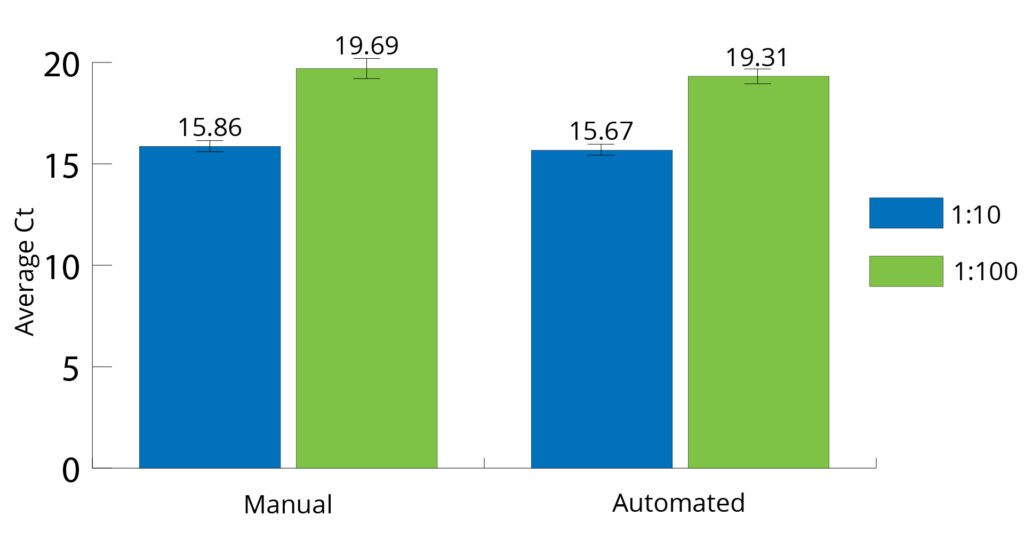
Figure 12. Gram Positive Bacteria Bacillus subtilis was spiked into 250 µL stool samples and isolated using the Mag-Bind® Universal Pathogen 96 Kit. Automated isolation was performed using the Hamilton Firefly Nimbus® 96 and compared to manual isolation methods. qPCR was performed on undiluted, 10-fold, and 100-fold dilutions. The ΔCt across dilutions was ~3.3 for both manual and automated methods, indicating minimal inhibition.
Comparable Yields Between Manual and Automated Extraction Methods for Stool Samples
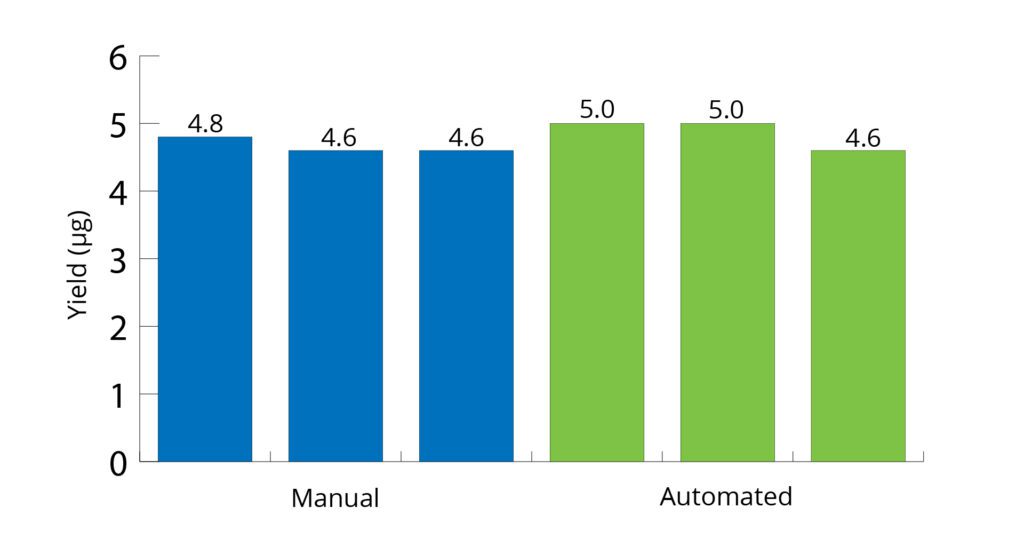
Figure 13. Yeast Saccharomyces cerevisiae was spiked into 250 µL stool samples and isolated using the Mag-Bind® Universal Pathogen 96 Kit. Automated isolation was performed using the Hamilton FireFly Nimbus 96 and compared to manual isolation methods. Quantification showed comparable yields of yeast DNA between manual and automated isolation methods.
Inhibitor-free Yeast DNA Isolation from Stool Samples
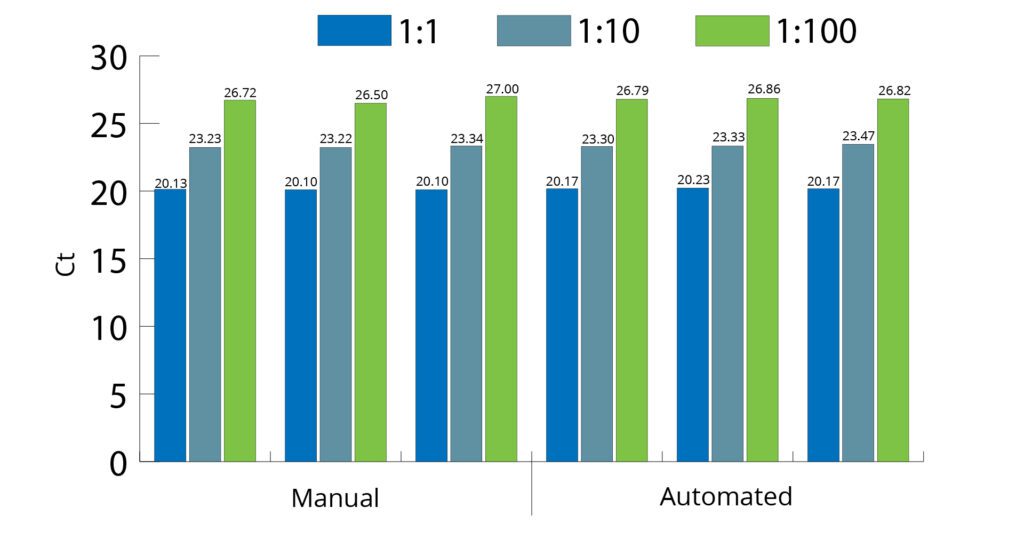
Figure 14. Yeast Saccharomyces cerevisiae was spiked into 250 µL stool samples and isolated using the Mag-Bind® Universal Pathogen 96 Kit. Automated isolation was performed using the Hamilton FireFly Nimbus 96 and compared to manual isolation methods. qPCR was performed on undiluted, 10-fold, and 100-fold dilutions. The ΔCt across dilutions was ~3.3 for both manual and automated methods, indicating minimal inhibition.
Consistent Automated Isolation of Gram-Positive Bacterial DNA
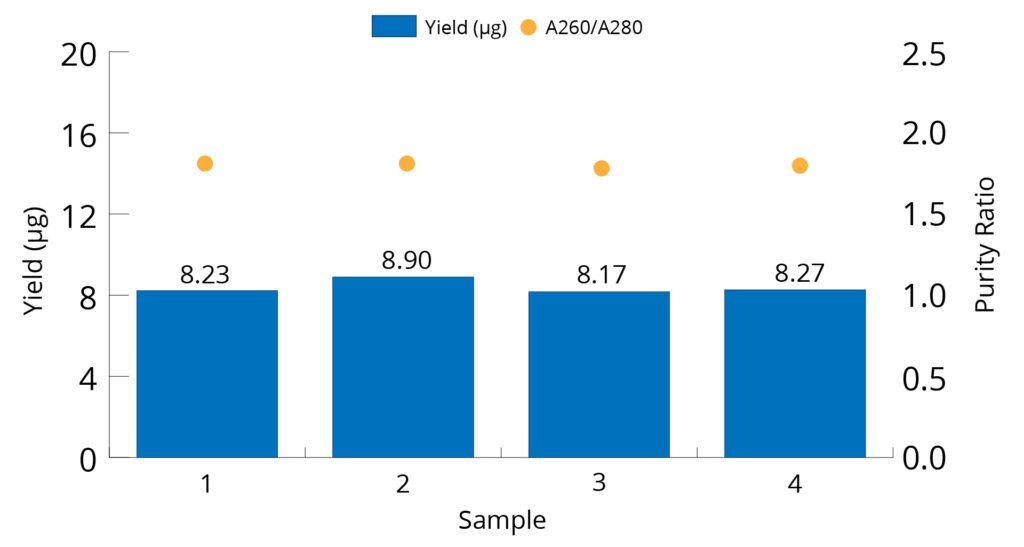
Figure 15. Gram Positive Bacterial DNA was isolated from 300 µL of Bacillus subtilis using the Tecan DreamPrep. NanoDrop Quantification showed A260/A280 ratios ~1.8 and yields between 8.1 and 8.9 µg for all samples.
Inhibitor-free Isolation of Gram Positive Bacterial DNA from Plasma
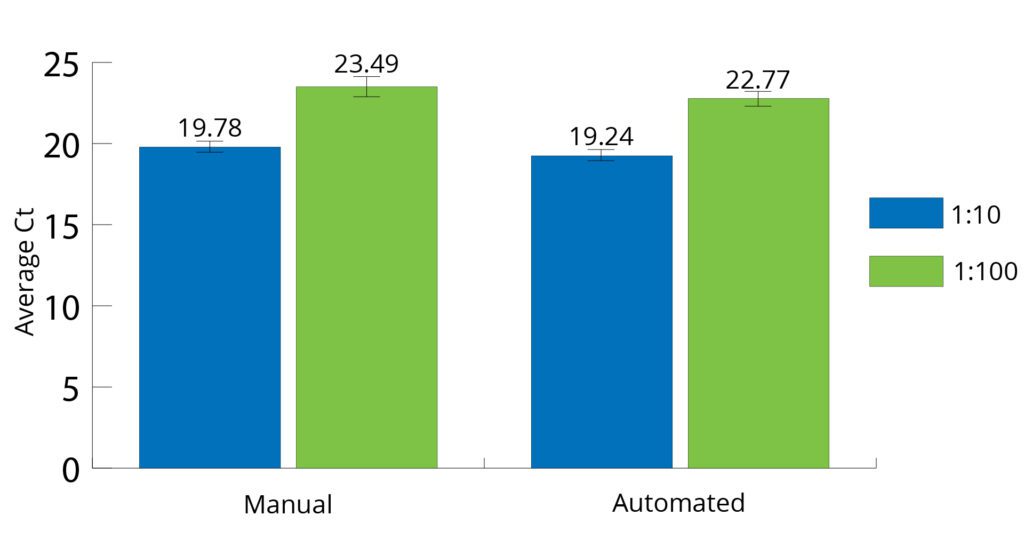
Figure 16. 100 µL Influenza A/B and 50 µL of Bacillus subtilis were spiked into 100 µL plasma. DNA was isolated using the Mag-Bind® Universal Pathogen 96 Kit on the MagBinder® Fit24 and compared to manual extraction methods. qPCR targeting B. sub was performed on 10-fold and 100-fold dilutions. The ΔCt between dilutions was comparable between manual and automated isolation methods, ~3.3, indicating inhibitor-free isolation.
Influenza Detection from Plasma using the MagBinder® Fit24 is comparable to manual method
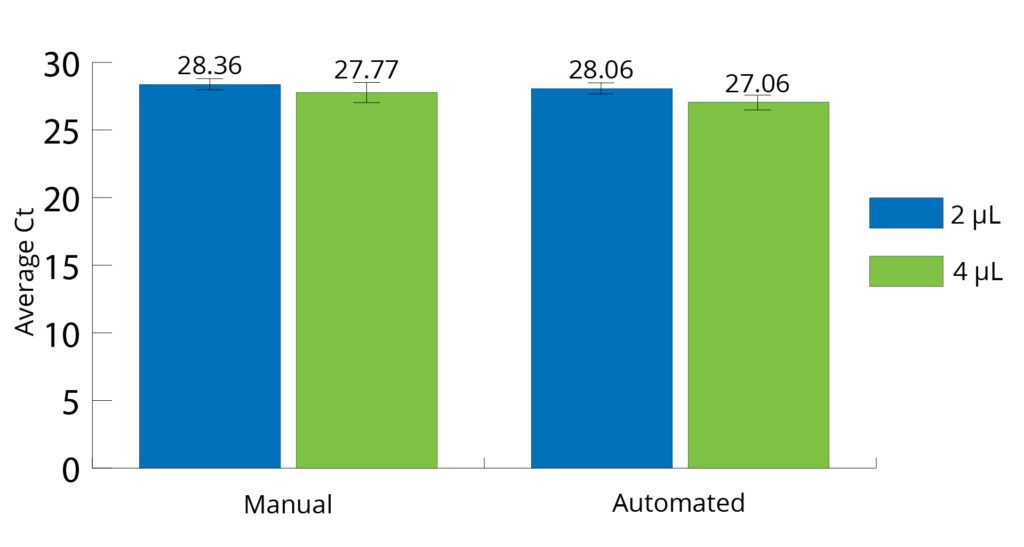
Figure 17. 100 µL Influenza A/B and 50 µL of Bacillus subtilis were spiked into 100 µL plasma. DNA was isolated using the Mag-Bind® Universal Pathogen 96 Kit on the MagBinder® Fit24 and compared to manual extraction methods. qPCR targeting Influenza A/B was performed on 2 µL and 4 µL dilutions. The ΔCt between dilutions was comparable between manual and automated isolation methods.
Inhibitor-free Isolation of Gram-Positive Bacterial DNA from Urine Using the MagBinder® Fit24
Figure 18. 50 µL of Bacillus subtilis was spiked into 200 µL urine. DNA was isolated using the Mag-Bind® Universal Pathogen 96 Kit on the MagBinder® Fit24 and compared to manual extraction methods. qPCR targeting B. sub was performed on 10-fold and 100-fold dilutions. The ΔCt between dilutions was comparable between manual and automated isolation methods, ~3.3, indicating inhibitor-free isolation.
Influenza Detection from Cells using the MagBinder® Fit24
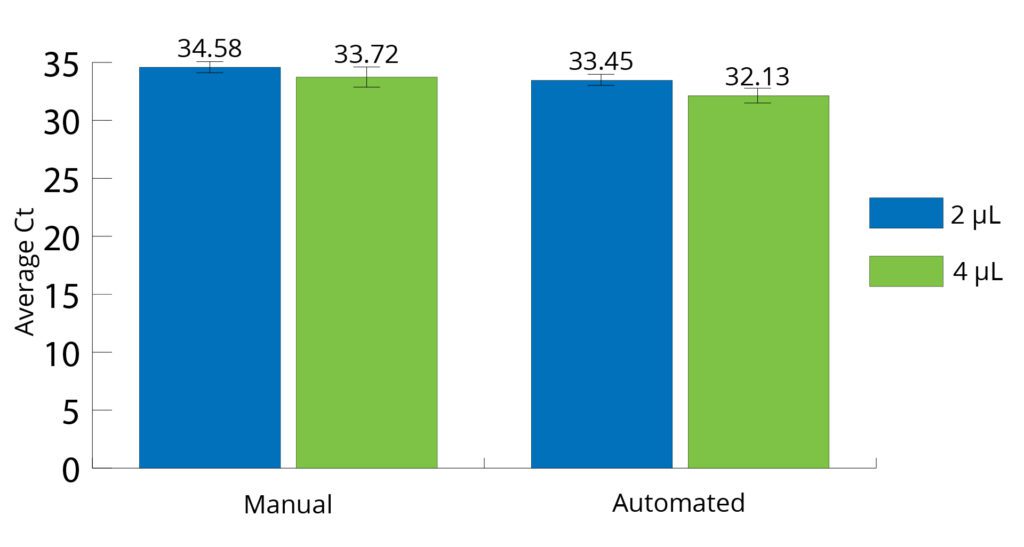
Figure 19. 75 µL of Influenza A/B was spiked into 175 µL cells. DNA was isolated using the Mag-Bind® Universal Pathogen 96 Kit on the MagBinder® Fit24 and compared to manual extraction methods. qPCR targeting Influenza was performed on 2 µL and 4 µL dilutions. The ΔCt between dilutions was comparable between manual and automated isolation methods.
Product Information
Safety Data Sheets
Shopping Cart
Scroll to Top
We use cookies to ensure that we give you the best experience on our website. If you continue to use this site we will assume that you are happy with it.